Friday, October 12, 2012

Provence Vacation - Part 3

Back in September, Muschi and Paschi took us on vacation to the Luberon region of Provence.  Here are some pictures and my notes on our time there. 

Wednesday

Donnie and Paschi fetch bread from the neighboring village of St. Saturnine.  Rain threatens.   We while away the morning at Le Rosier while Louisa takes her morning nap. Finally,we emerge from the house and drive to the nearby Colorado Provencal, a nature park with hiking trails that take you by the famous ochre cliffs. After feeling rain drops, we decide to abandon the Colorado and find an indoor activity.  Soon, we're driving though a downpour--nature confirming our judgement.  We head towards Gordes, in the hope of visiting an olive press museum we'd passed on an earlier day.

Gordes


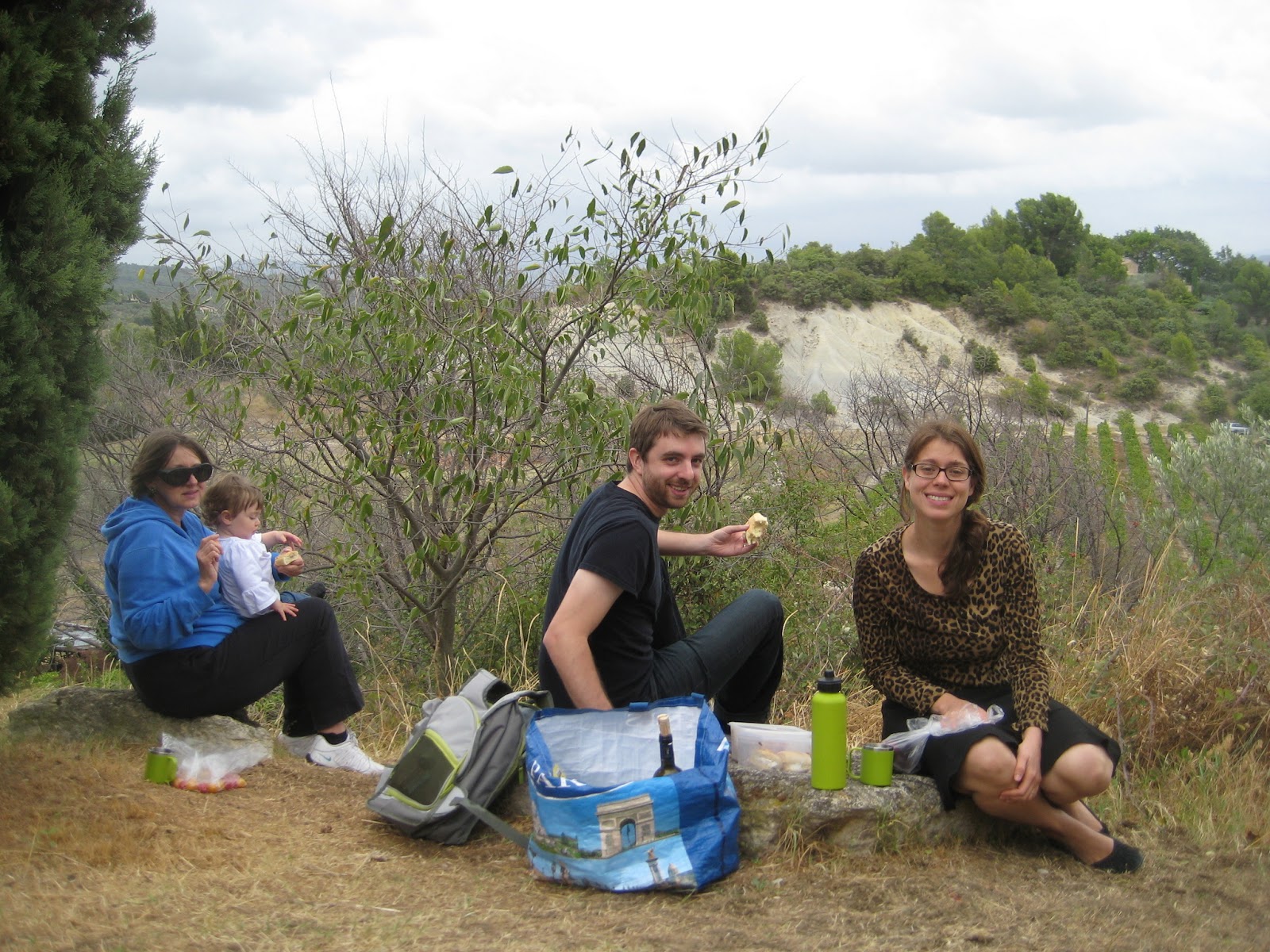
We eat a picnic lunch at a scenic overlook below Gordes, and after meandering through several tiny villages, we find the museum.

The olive press museum, Le Moulin des Bouillons, was created after Frederique Duran, a glass artist, purchased an old farm building and found the remains of a Gallo-Roman olive press in the basement.  She turned the farm into a museum complex, with the olive press museum on one side and a glass museum on the other.  Surrounding the glass museum is a garden featuring the artist's own glass and metal sculptures.

The mill, where the olives are ground before pressing.  Behind, a window by Frederique Duran.

In the sculpture garden.


Though Frederique Duran's chunky, geometric style is not to my taste, the vision and reverence of the place impress me.  It's obviously the work of many years and its creation fueled by lofty idealism.  The two small museums are meticulously designed to tell a story about man's quest to master his environment.  There's a mystic lilt to the information leaflet they give us at the glass museum.  Its description of the evolution of glass making is full of exuberant declarations like "man learns to shape clay.  He has made something out of Earth and has become like a god!"

We have an excellent guide at the olive press museum and she provides my favorite factoid of the trip:

*Roman amphora used to contain oil and wine, are pointed on the bottoms, because the ships the used to transport them used sand as balaste.  The pointed vessels could be driven straight into the sand, creating a more stable arrangement than if the vessels were flat-bottomed like ours. 

Two take-aways from the glass museum:

*The advancement of technology sometime happens through serendipity.  They theorize that glass blowing was discovered when one of the workers who was blowing through a reed to get the melting fire hot dropped one end of his reed into the molten glass.  He tried blowing on the reed to clear out the glass glass blowing was born.

*How necessary glass technology was to the advent of modern science.  It's easy to take beakers, flasks, and test tubes, for granted.  Many Enlightenment scientists had to become glassblowers to come by needed equipment.


That evening, Donnie and I go out for dinner leaving Muschi and Paschi to babysit.  We eat at a nearby restaurant, The Colorado  The atmosphere is friendly and relaxed.  The smell and heat from the wood pizza oven make the damp night cozy.  We both order the the menu fixe and drink a bottle of rose.  It's a lovely dinner.  We talk about education, which seems to be our favorite dinner topic these days. 

Thursday, October 11, 2012

Provence Vacation - Part 2

In September, Muschi and Paschi took us on vacation to the Luberon region of Provence.  Here are some pictures and my notes on our time there.

Tuesday

Morning.  Paschi, Donnie and I head to the Rustrel bakery for the daily bread.  We buy a baguette and a fougasse.  (A fougasse is made from olive oil dough which is rolled flat and slit, producing a branching appearance and lots of nice, chewy crust.  The Rustrel bakery uses a wood burning oven making their fougasse is particularly good).  We also buy two little cakes--one apricot, the other chocolate with pears--to eat that day for Louisa's birthday.

Later in th morning, after Louisa goes down for her nap, Paschi, Muschi  and I head to Apt.  Paschi sits in the car while Muschi and I visit the Apt farmers' market.  We buy fruit, pate, lavender essential oil, zinnias, wine, and one bar of very expensive soap.  

A group of school children visiting the produce stand.

Birthday zinnias!


A gate leading to the old city of Apt


Back at Le Rosier, we celebrate Loulou's first birthday. I'm grateful that her birthday has fallen during this vacation.  It's so good to be with family.  The fact that we're traveling means the event is nice and simple.  We have a good lunch under the grape arbor, sing happy birthday, and open a few presents.   Louisa doesn't need any help from us blowing out her candle--the wind does it for her.


Now, I'll take a break from the travel narrative to note that Louisa's first year has gone by so quickly and sweetly!   I've heard different opinions on whether it's easier to transition from no children to one child or one child to two.   For us, it has been much easier (and less angsty) to go from one to two.  I credit Loulou's cheery and affectionate personality, and the wonderful way that she and Maria get along.   Louisa has brought a fullness of joy to our family life.  We love her so!  Now back to the log...


Following lunch, we have "quiet time" (Louisa sleeps, Maria doesn't), and then rush to get to the Lavender Museum before it closes.  The Lavender Museum is an exquisite learning and indoctrination experience.   The whole place smells of  lavender, and the walls are painted a gentle purple gray.   Exhibits show the process of extracting essential oil from the plants, and the evolution of distillation technology.    

Now I'm going to get a bit pedantic, and recount a few of the interesting factoids we learned at the museum.  Please feel free to skip:

* There are two different plants that are often called "lavender."


There is fine lavender and lavandin.  Fine lavender is the natural plant--the one that Provencal peasants gathered wild in the mountains and sold to perfumers to augment their income.  Fine lavender can only grow in a narrow range of altitude.  The plant has a fine, subtle fragrance and many medicinal qualities.   

Lavendin is a hybrid of fine lavender  and can grow almost anywhere.  It has a much stronger, headier scent, and is used to perfume detergents.  Lavendin is much easier to grow and produces much more essential oil per unit volume.   According to the museum, lavandin has no medicinal qualities.

Hearing this, does it surprise you that the museum is the side business of a fine lavender farm?  Promoting the benefits of fine lavender over lavandin is one of their explicit missions.   

(Learning this distinction, Muschi and I realise that the essential oil we bought in the morning at the farmers' market must have from lavandin rather than fine lavender.  Fine lavender essential oil would have cost us three times as much.)

Other factoids:

*The city of Grasse became a perfume capital after local leather workers discovered they could perfume their products to mask the unpleasant smell of tanning chemicals.  Thus the guild of leather workers became the guild of leather workers and perfume makers.

*Flower oils are distilled in much the same process, with much the same equipment, as alcohool.  One of the the stills we saw had been rendered inoperable by the customs officials, in order to  prevent its owners from using it to make illegal cognac.   Now we're thinking that distillation really needs to be covered in our future homeschooling curriculum.


Returning to family travel narrative....

At last, we break free of the museum's beautiful-smelling and pricey gift store and pile back into the car.  While Paschi is setting the Garmin, he discovers that we are not far from another notable site, Fountaine de Vaucluse, the source of the Sorgue River.  We spend twenty minutes driving through narrow country lanes, into the Sorgue river canyon and arrive at the village as night is falling. 

As the trip was unplanned and unresearched, I'm not prepared for the sublime landscape that greets us.  The Sorgue river emerges from the foot of cliffs, which loom over the valley like petrified waves. 

It was too dark to take pictures when we were at Fountaine de Vaucluse, but we spotted this painting of the Source several days later when we visited Avingnon.

We follow the path up the the river, up to the source, where the water appears suddenly, at full river strength, from the shaddowy rock.   We hear scratching noises presumably made by spelunkers investigating a nearby cave.  I pray that no one close to me ever takes up that dreadful hobby.

As we drive away, I'm grateful to have seen the source, but glad to put the hulking cliffs behind me.  Donnie declares that the Sorgue is now his favorite river.  The way home is difficult driving---dark, winding farm lanes.  We are grateful when we pull into the driveway of the La Grand Bastide.

Another great day in Provence.

Some video from Loulou's birthday festivities:

Monday, October 8, 2012

Provence Vacation - Part I

Back in September, Muschi and Paschi took us on vacation to the Luberon region of Provence.  Here are some pictures and my notes on our time there.


Saturday

We arrive at La Grand Bastide at sunset. The housekeeper and her daughter are there to show us our quarters. I can hardly contain my glee over the beauty of the place.  La Grande Bastide is a large, four-century-old farmhouse.  Our apartment, "Le Rosier" was named for the rose bushes that flourish in the courtyard outside.  The apartment is big--the size of a four bedroom house. And there's a pool!  More importantly, there's a dishwasher!  But despite its modern comforts, "Le Rosier" still has French farmhouse charm in form of tiled floors, thick plaster walls,* age-darkened ceiling beams and functional wooden shutters.   From the second story, there are views of the tree-covered ridges and neighboring vineyards.


After unloading the car, we go to dinner in the nearby village of Rustrel.  We eat outdoors at a restaurant on the town square.  Maria plays at the nearby playground while we wait for our food.  It's a memorable meal--ravioli with pistou (pesto), fish cassoulet, and steak with frites, washed down with a friendly red table wine.  The relaxed dress of our fellow restaurant goers and the easy manner of the waiter herald the pleasures of country living.  It has a very different feel from the Paris metro area.


Sunday

Muschi walks to Rustrel in the morning to pick up croissants and a lovely sourdough baguette.  After breakfast, Muschi and Maria head out to the Vide Grenier ("empty basement"- French for garage sale) in Rustrel.  Paschi, Donnie, Louisa and I go to Apt for Mass at the Cathedral of St. Anne. The Cathedral is a baroque beauty, but rather dark and in need of restoration.

In the cathedral, there is a fine image of the Annunciation.  Mary wears an expression not often seen  depictions of the Annuciation--a look of avid interest.

Following mass, the alter servers produce ropes that had been tucked out of sight during the service.  It seems the Cathedral bells are hung directly over the alter.  The children ring the bells, catching onto the ropes allowing themselves to be lifted off the ground.   
Statue of St. Anne, atop the cathedral in Apt.

A gate tower near the Apt Cathedral, with Provencal style bell cage.

Succulents on the window sills.

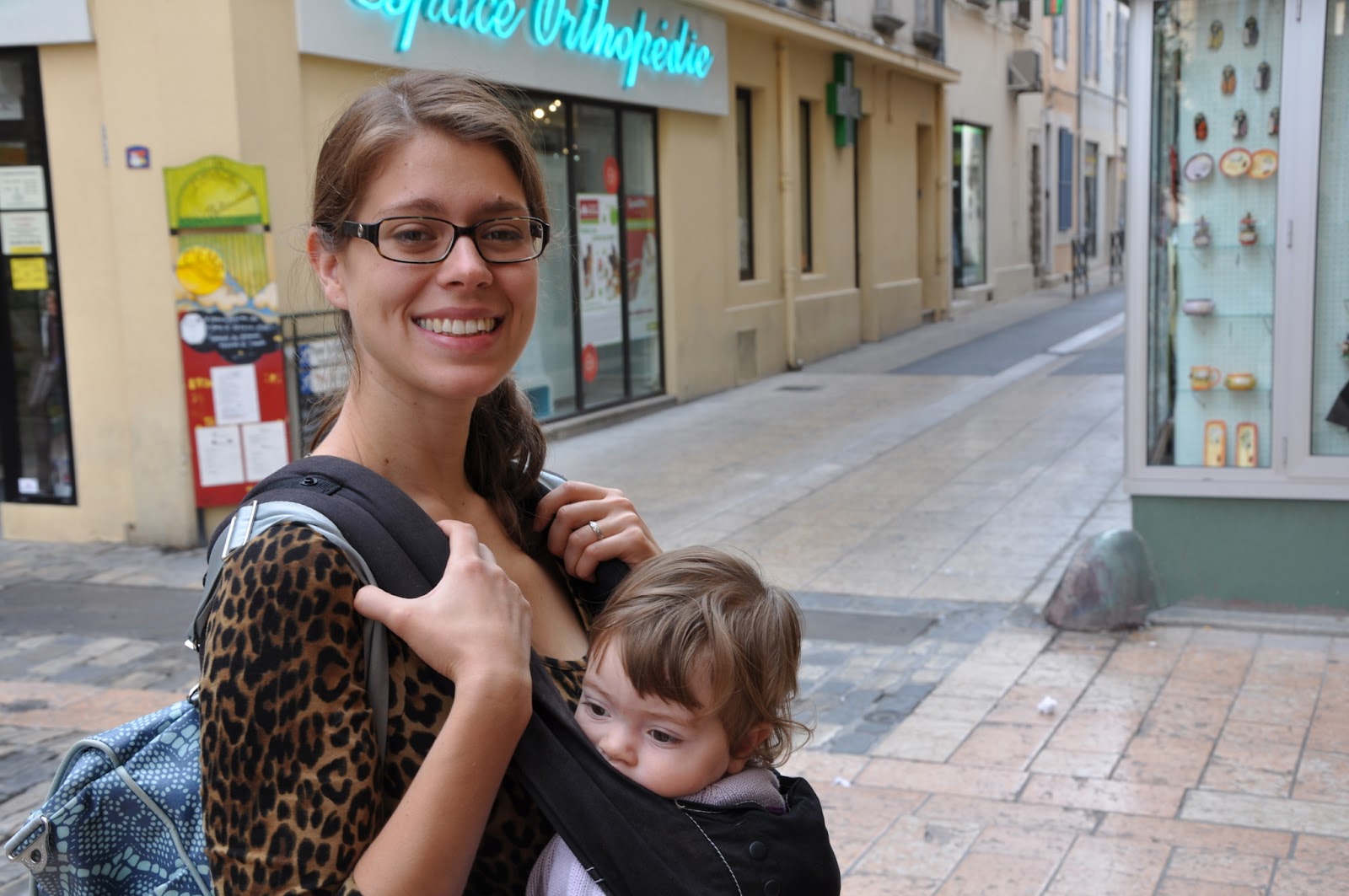
Look at the leopard print top Muschi brought me!  She assures me that leopard is "in."  I like it very much.

We reunite with Muschi and Maria in Rustrel and lunch at the Auberge de Rustrel, another restaurant on the village square.  The Auberge contains an old well (caged over for safety, but dramatically lit from inside.)  The well captures Maria's imagination, and keeps her distracted while we wait for bread to be brought to the table.  There's another wonderful table wine---unfortunately, we don't ask what it is.  Aside from the wine, the most memorable part of the meal is the dessert--orange-flavored creme brullee, topped with two slivers of candied orange peel.

Muschi's vide grenier finds.


Monday

Rain.  Muchi and Paschi go grocery shopping in Apt while the Sheehys stay at home.  Louisa takes her morning nap.  After several hours, Muschi and Paschi return home and the rain stops.  We stow the groceries and head out under heavy clouds to the Pont Julien, a Roman Bridge from 3 BC.  We chose a rock in the riverbed with a good view of the bridge and unpack our lunch.  We drink tea and eat sandwiches, slices of Chausse de Moins cheese and pears.   The sky clears.  Maria plays in the sand. 
Look, no mortar!

Paschi bring the thunderheads in his wake!  Bwahhhhhhahahaha!


View from on top of the bridge.


Hoping to take advantage of the blue skies, we pile back in the car and head toward the hilltop town of Gordes.   The girls and Donnie sleep in the parked car while Muschi, Pashci, and I go in search of a photo op.  We find one.


We rejoin Donnie and the kids and walk uphill into the city.  Maria and the men stake out a sunny spot next to the chateau while Muschi and I visit boutiques.  The shops sell olive wood, honey, soap, lavender sachets, grinders full of herbs de Provence, and colorful traditional fabrics.  There are all manner of ceramic items decorated with Provencal motifs--olive branches, lavender, and cicadas.  After Muschi and I break free from the thrall of the shops, we walk down a few more cobblestone alleys, finding more great views.


Look who's awake!


The next stop is Rousillon.   A sign at the entrance of the town declares that it is "One of France's Most Beautiful Villages"--a distinction is shares with Gordes.  Rousillon owes its unique appearance to it's ochre tinted buildings.  These building serve as a kind of swatch catalog for all the colors that can be found in the ochre clay deposits surrounding the town.  (Until the early 20th century, ochre mining was one of the area's main industries.  The ochre was used to make pigments that found their way into all sorts of things--from sausages to artists' paints.)  I'm glad that Muschi is wearing her bright blue sweatshirt--it's the perfect compliment to the town's parade of oranges. 


We eventually find our way to the cemetery.  It's a walled plot, with above-ground mausoleums.  It overlooks the town, a benevolent reminder of past generations.  


Finally, we descend the ruddy heights and ride back to La Grande Bastide.  On the way home, I think about the steep, winding alleys and scenic heights of Gordes and Rousillon, and wonder if they'll reappear in my dreams.

We end our busy day with a homemade dinner of fried mashed potatoes, sausages and salad.